

Keeping memories · 3 min read
How to keep their little voice
Simple ideas for recording your child's voice, saving funny words and ordinary conversations, and making the clips easy to find again.
KEEPING MEMORIES
Simple ways to save children's artwork, from good photographs and their own explanations to choosing a few originals together.
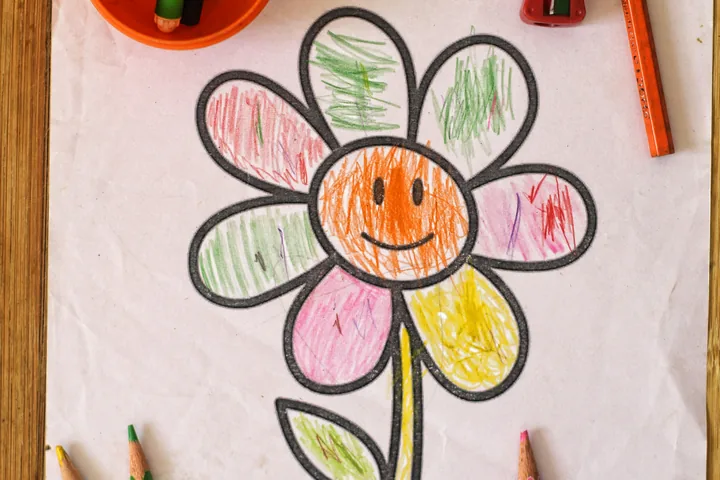
Our fridge has held drawings, school certificates and the sort of masterpieces you can't possibly take down. There are never enough magnets.
Paper has a way of arriving in a family home faster than you can decide what to do with it. One picture is a treasure. Thirty-seven pictures require a conversation with the kitchen drawer.
You can keep the story without keeping every sheet forever. A few originals, some good photographs and the words your child uses to explain them make a lovely collection.
“Tell me about this” can reveal things the drawing alone will not.
Who is in it? What is happening? Which part did they make first? You might discover that the small orange shape is a person, a planet or a machine that makes toast. Better to ask than to spend ten years admiring the wrong subject.
Write down a short version of the explanation with the date and their name. If they give the picture a title, keep their title. Your archival description can sit underneath it.
For a recording of the explanation, see our guide to keeping little voices. A thirty-second clip may be more entertaining than anything you could write about the picture yourself.
Put flat work on a plain surface in even daylight. Stand directly above it where you can do so comfortably, avoid a strong shadow across the page, and check that the edges are in the picture.
Look at the photograph before putting the original away. Can you see the details? Is it reasonably sharp? Have you accidentally recorded mainly your own shadow?
For a model or a construction, take a couple of angles and one picture showing its size. A child standing beside it can give context if they want to be in the photograph. Their explanation may be the most useful part when the object itself eventually comes apart.
Save the original image file and any note together. If you crop a copy for an album, keep the full image too when it contains details you might want later.
We’re making room for this in Kins too. A photograph of their creation can sit with a written memory about what they made and what they told you it was. Save a voice recording of the explanation if you’d like the sound as well. The app is still on its way, but keeping the picture and the child’s words is very much part of what we’re building it for.
Ask which pictures they want to keep and why. Their favourite may be a page you would have missed, because making it was the important part.
You could keep a small folder for the current year, with a handful of favourites moved into a longer-term collection. A display area can change without every change becoming a dramatic removal ceremony.
Be thoughtful about personal pieces. A picture or written page may reveal something a child does not want shared. Ask before posting, and allow an older child a say in what goes into a family collection.
Choosing together works best when it does not become a judgement of whose picture was “good enough”. You are making room, rather than grading an exhibition.
There is no need to use all five. Choose the one you will actually maintain.
For a bigger paper backlog, start with one pile. Photograph a handful, keep a few originals and stop when you have had enough. Save a separate copy of the digital collection if losing it would upset you.
The fridge is allowed to become visible again. The memory can live somewhere other than underneath the fifth magnet from the left.
Keeping memories · 3 min read
Simple ideas for recording your child's voice, saving funny words and ordinary conversations, and making the clips easy to find again.
Keeping memories · 3 min read
A manageable way to organise family photos: start with five favourites, add useful context and check your copies before deleting anything.
